
ANNUAL WORKSHOP 2026: REPORT: 𝗦𝗲𝗰𝘂𝗿𝗶𝘁𝘆, 𝗥𝗲𝘀𝗶𝗹𝗶𝗲𝗻𝗰𝗲, 𝗮𝗻𝗱 𝗦𝘂𝘀𝘁𝗮𝗶𝗻𝗮𝗯𝗶𝗹𝗶𝘁𝘆 𝗶𝗻 𝗘𝗻𝗲𝗿𝗴𝘆 𝗟𝗮𝘄

RECENT DEVELOPMENTS IN SWITZERLAND AND THE EUROPEAN UNION

28 August 2026 – Università della Svizzera italiana, Lugano, Switzerland

The 2026 Annual Meeting of the Swiss Energy Law Association (SELA), organised in cooperation with the Center for Law and Sustainability at the University of Lucerne, brought academics, regulators, practitioners and energy-sector representatives to USI’s East Campus in Lugano on 28 August.

Werner Luginbühl, President of the Swiss Federal Electricity Commission (ElCom), opened the substantive programme with a keynote on the fundamentals of the Swiss electricity system and the importance of a Swiss-EU electricity agreement. From there, the meeting moved across a deliberately broad set of questions: climate litigation, nuclear policy, battery storage, gas security and Switzerland’s place in the European electricity market.

What connected these otherwise different subjects was a practical concern that surfaced repeatedly over the course of the day. The energy transition is no longer simply a matter of fixing a decarbonisation target and identifying the technology that can deliver it. Reliability, infrastructure, market design, legal competence and investment increasingly have to be considered together, often within the same regulatory or contractual problem.

WELCOME REMARKS

Opening Remarks

Professor Ilaria Espa of the Università della Svizzera italiana (USI), Lugano, Secretary-General of SELA and organiser of the Annual Meeting, welcomed around 50 participants to the University’s new premises in Lugano. Together with her team, she thanked those present for taking part and for their continued engagement with SELA’s work.

Professor Thomas Cottier of the University of Bern, President of SELA, began by questioning the usefulness of some of the divisions through which energy lawyers habitually organise their work. Public law, private law, commercial law, European law and international law remain distinct fields, he noted, but the problems generated by the energy transition rarely respect those boundaries.

A climate claim may start with ordinary tort doctrine and quickly engage human-rights law; access to an electricity network may turn on regulation, market design and contract at once. Cottier did not suggest that established legal categories had lost their value. His point was rather that they no longer provide self-contained explanations of the underlying problems. He also welcomed the strong in-person attendance, encouraging participants to make use of the informal exchanges that tend to disappear in online formats.

Professor Sebastian Heselhaus of the University of Lucerne, Director of the Center for Law and Sustainability, placed the same issue in a broader political setting. Climate regulation is meeting stronger resistance just as energy security has returned to the centre of public debate. For Heselhaus, these developments should not be treated as separate pressures. They instead sharpen the question of what a sustainable energy policy must be capable of delivering in practice. Cost, reliability and implementation are therefore not external objections to sustainability; increasingly, they are among the conditions on which climate policy depends for its political and legal credibility.

PANEL I

Climate Litigation and the Energy Transition

Dr Andreas Hösli (Kellerhals Carrard), Dr Gabriel Webber Ziero (Swiss Re), Johannes Wendland (HEKS/EPER) and Professor Angus Johnston (University of Oxford) approached climate litigation from private-law, corporate, comparative and regulatory perspectives.

Much of the discussion turned on Asmania et al. v Holcim AG. Four residents of the Indonesian island of Pari are seeking emissions reductions and compensation for alleged climate-related harm under Article 28 et seq. of the Swiss Civil Code. The case remains at the procedural stage. The Cantonal Court of Zug allowed the action to proceed, rejecting the proposition that climate policy necessarily falls outside the competence of civil courts and that the claim should be treated as an actio popularis. None of the more difficult merits questions has yet been resolved: causation, damage and the attribution of a legally relevant share of responsibility all remain open. Precisely for that reason, the proceedings offer a useful illustration of how familiar private-law concepts are being tested by cumulative, geographically dispersed and transnational forms of harm.

A different difficulty arises from the regulatory environment in which multinational companies operate. ESG commitments encouraged or required in one jurisdiction may attract antitrust, fiduciary-duty or consumer-law scrutiny in another. The resulting legal exposure makes consistency between public statements, governance arrangements and internal implementation increasingly important. The wider litigation landscape, including Milieudefensie v Shell and Lliuya v RWE, points to the same underlying problem: recognising climate harm in the abstract is only one step. Courts and regulators must still translate global objectives into company-specific duties and into rules of attribution that can operate within existing legal frameworks.

The exchange repeatedly came back to ordinary legal reasoning rather than to a wholly new body of climate law. Individual loss, causation and responsibility remain central even when the factual setting is global. Yet the hierarchy of norms and the timing of intervention can alter the legal analysis considerably. Climate objectives with constitutional or EU-law force may constrain regulatory choices differently from discretionary mandates; similarly, consultation and regulatory design may offer a more effective point of intervention than judicial review once a measure has already been adopted.

KEYNOTE ADDRESS

Swiss Electricity Security and the European Dimension

Werner Luginbühl then shifted attention from litigation to the physical operation of the electricity system. Switzerland consumes roughly 60 TWh of electricity each year, but the annual total masks a marked seasonal imbalance. Summer production commonly leaves a surplus, whereas winter brings a need for imports. In winter 2025/26 those imports reached almost 7 TWh, partly because the Gösgen nuclear power plant was unavailable.

For Luginbühl, that seasonal pattern is the reason annual self-sufficiency can be a misleading measure of security of supply. What matters is not only the volume produced over twelve months, but whether enough energy and capacity are available when the system is under the greatest strain.

His assessment of renewable expansion was similarly nuanced. Rooftop solar has grown quickly, adding roughly 5 TWh over five years, while progress elsewhere has been slower. Alpine photovoltaic projects have faced questions of profitability and local acceptance; hydropower remains procedurally demanding; wind development continues at a modest pace. Luginbühl referred, with some humour, to the succession of federal ‘Express’ measures designed to accelerate energy infrastructure. The underlying point was less light-hearted: legislation can shorten procedures more readily than it can solve the financing, authorisation and construction challenges of major infrastructure.

Storage raises a different set of questions. Batteries can shift photovoltaic production over several hours, respond rapidly to price signals and provide short-term balancing services, and Luginbühl therefore regarded them as an important part of the future system. Their limits are equally important, however. They do not replace seasonal storage, while Swiss reservoirs operate on an entirely different scale. A system with a larger share of variable generation will still need dispatchable capacity and reserves. Treating all forms of storage as a single regulatory category can consequently obscure the fact that they perform very different functions.

The European dimension occupied a substantial part of the keynote because Switzerland is physically embedded in the continental electricity network even though it has remained outside important European market-coupling and regulatory processes. The result is an increasingly uncomfortable asymmetry: Swiss operators are affected by rules and coordination mechanisms over which Switzerland has limited influence. Luginbühl therefore presented an electricity agreement with the European Union as both an economic and an institutional issue. In his account, an agreement would strengthen import possibilities, access to balancing platforms, regulatory information and participation in the structures through which cross-border electricity is already managed. Cottier picked up the institutional point in the discussion, observing that integration also means being represented where relevant decisions are taken. For a country at the centre of the European grid, resilience cannot be reduced to national self-sufficiency.

PANEL II

Nuclear Energy and the Future of Swiss Energy Policy

Dr Kateryna Holzer (University of Eastern Finland and SELA), Pascal Hachem (Bär & Karrer), Dr Kim Fyhr (University of Eastern Finland) and Lukas Mühle (GW Innovations GmbH) examined nuclear energy through the lenses of legal policy, investment, waste management, technology and security of supply.

The starting point was political as much as legal: the different responses to Chernobyl and Fukushima provided the background to a discussion of the Swiss framework. Existing Swiss reactors have no fixed statutory closure date. Their licences are open-ended, and continued operation depends on compliance with safety requirements under ENSI supervision. The present prohibition concerns new general licences for new nuclear power plants. That distinction becomes more consequential as expected operating lives lengthen and existing plants are increasingly discussed as a bridge while replacement capacity develops.

Finland offered a useful contrast: there, nuclear generation and renewables have expanded alongside one another, while the Mankala model shows how industrial and utility shareholders can share generation costs. Even so, political acceptance and a supportive legal framework do not eliminate the financing difficulties associated with new nuclear construction. The Olkiluoto repository illustrated another feature of the sector: its extraordinary time horizon. Developed over decades, with sustained local engagement and an effective municipal veto, it showed how deeply questions of nuclear policy can depend on long-term institutional and local consent.

Finally, small modular reactors may gain advantages from standardisation and factory production; fusion, by contrast, continues to make scientific progress without yet resolving the engineering challenge of commercial electricity generation. The discussion of cost overruns in large projects also resisted a purely technological explanation. Design maturity, specialised suppliers, contracting structures and project management all matter. Nuclear fuel itself is comparatively easy to stock, but dependencies remain in fabrication and specialised components, another reason why Swiss energy security cannot be assessed in isolation from the wider European system.

PANEL III

Battery Storage, Flexibility and Energy Infrastructure

Dr Moritz Wüstenberg (Streamtech Solutions AG and SELA), Louise Kavacs (50Hertz), Dr Rolf Endriss (AEM Massagno) and Riccardo Albieri (DXT Commodities) focused on the regulatory and contractual problems created by battery storage.

Batteries sit uneasily within legal categories built around a clearer division between producers and consumers and single installation can draw electricity from the grid, inject it again, provide balancing services and react almost immediately to market prices. The difficulty becomes especially visible where connection capacity is scarce. German experience suggests that a strict first-come, first-served model may tie up valuable capacity in projects that are not sufficiently mature, prompting a move towards a ‘first ready, first served’ approach. Grid-connection law then does more than regulate technical access: in practice, it also allocates a scarce economic resource.

Connection is only the first part of the problem because once batteries are operating, price signals and local network needs may pull in opposite directions: many units may charge or discharge at the same time because the market rewards that behaviour, even where the local grid would benefit from the reverse. Swiss regulation is beginning to respond by limiting the extent to which reinforcement costs can be socialised and by treating flexibility as an asset that generally remains with the owner but can be contracted by the network operator. Used in that way, flexibility may postpone or even avoid some physical grid reinforcement.

These network questions feed directly into contract design: a BESS optimisation agreement has to allocate not only price and output risk, but also practical control over charging, discharging and availability. Dispatch rights, degradation, network constraints, lost availability and changes in market rules can therefore become central bargaining points. The commercial value of storage, as the speakers emphasised, depends not simply on the battery technology itself but on who is legally entitled to use its flexibility, when, and on what terms.

PANEL IV

Security of Gas Supply

Professor Thomas Cottier moderated the final panel with Professor Kim Talus (University of Eastern Finland and University of Helsinki), Brigitta Kratz (Kratz Legal) and Matteo Quadranti (Quadranti & Molteni; Ticino Grand Council). Their discussion moved between the European, Swiss and cantonal dimensions of gas security.

The European experience after 2022 exposed weaknesses in a security model built largely around liberalised markets, diversification and emergency rules. Physical availability was only one part of the crisis; affordability and the ability of states to act in solidarity under simultaneous pressure proved equally important. This led to a distinction between security of supply and resilience. The former asks whether the commodity can be obtained. The latter reaches further, taking account of concentrated supply chains, control over strategic inputs and the capacity of the system to keep functioning when ordinary market assumptions fail. On that view, diversification may carry an additional cost and require public intervention rather than amounting merely to a switch from one supplier to another.

Switzerland is particularly exposed because it produces no natural gas, has no large-scale seasonal storage and does not automatically benefit from EU solidarity arrangements. During the 2022 crisis, this made a combination of federal measures, industry coordination and cross-border solutions necessary. The discussion also underlined how closely gas and electricity security are linked: reserve power plants depend significantly on gas or dual-fuel capability, but they can support the electricity system only if the required fuel is itself available at the moment of stress.

Ticino brought the longer-term infrastructure dilemma into sharper focus since the canton has historically received gas through Italy, while its energy and climate policy foresees a substantial reduction in fossil-gas use. Networks may therefore still need investment to remain reliable at the very moment when their traditional role is expected to decline. Some infrastructure could later be adapted for renewable gases, synthetic methane, hydrogen or other Power-to-X products, but the timing of those choices is delicate. Overinvestment risks locking in assets and uses that policy is seeking to phase down; withdrawing too early could strand infrastructure that might still perform a useful transitional function.

Electrification offers one route away from fossil gas, but it does not make the underlying security problem disappear. It shifts part of the burden onto winter electricity supply, storage and grid capacity. The session nevertheless ended with a clear recommendation to progressively move away from gas and replace it with electricity where the electricity system can accommodate the additional demand.

CONCLUDING REMARKS

Cottier’s closing remarks did not try to compress the day into a single message. Instead, he returned to the points on which uncertainty remains. Climate litigation is moving towards a more recognisable debate about duties to act, but causation, damage and the proper space for political choice are still difficult. On electricity, his position was more definite: he reiterated that an agreement with the European Union is indispensable to Swiss security of supply.

Other sessions pointed to different forms of interdependence. Finland’s experience with nuclear power raised questions about technology neutrality, public acceptance and the consequences of longer operating lives. The battery discussion, meanwhile, showed how closely network physics, market incentives and contractual design have become connected. On gas, Cottier returned to the need to reduce structural dependency where possible, particularly through electrification when the electricity system can absorb the additional load.

Heselhaus closed the circle by returning to the interdisciplinary theme of the opening remarks. None of the issues discussed during the meeting could be understood fully from within a single field of law. Tort doctrine now interacts with human-rights law and climate policy; new technologies produce regulatory and contractual questions at the same time; infrastructure choices cannot be separated from market design or security of supply. Espa added a geographical dimension. Swiss energy law may be exercised through national and cantonal competences, but it operates inside European networks and global supply chains.

Seen together, the sessions made clear that security, resilience and sustainability cannot easily be arranged according to a fixed hierarchy, since measures designed to strengthen one objective may create new pressures elsewhere: greater resilience may come at a higher cost, faster decarbonisation may place additional strain on networks, and infrastructure developed for one stage of the transition may later need to be adapted to a different role. Rather than temporary inconsistencies that will disappear once the right technologies have been identified, these tensions are likely to remain an inherent feature of the energy transition itself.

The legal challenge is therefore to manage this process of continuing adjustment by providing a framework that is sufficiently stable to support investment, coordination and long-term planning, while remaining flexible enough to respond to changes in technology, markets and the physical energy system. It was this need to reconcile stability with adaptation, more than any individual technology, dispute or regulatory question, that ultimately connected the different discussions throughout the meeting.

Written by Katarina Mirkovic (PhD Candidate, Université de Genève)


Links for the materials:

Rolf Endriss – AEM Presentation

Angus Johnston – Presentation

Dr. Hachem – Nuclear Energy in Switzerland

Gabriel – ESG Developments

Hoesli, Asmania et al. – Presentation

Johannes Wendland – Climate Litigation

Louise Sophia Kavacs – Beyond Grid Connection: Integrating BESS into Germany’s Power System
Matteo Quadranti – Gas Supply in Ticino

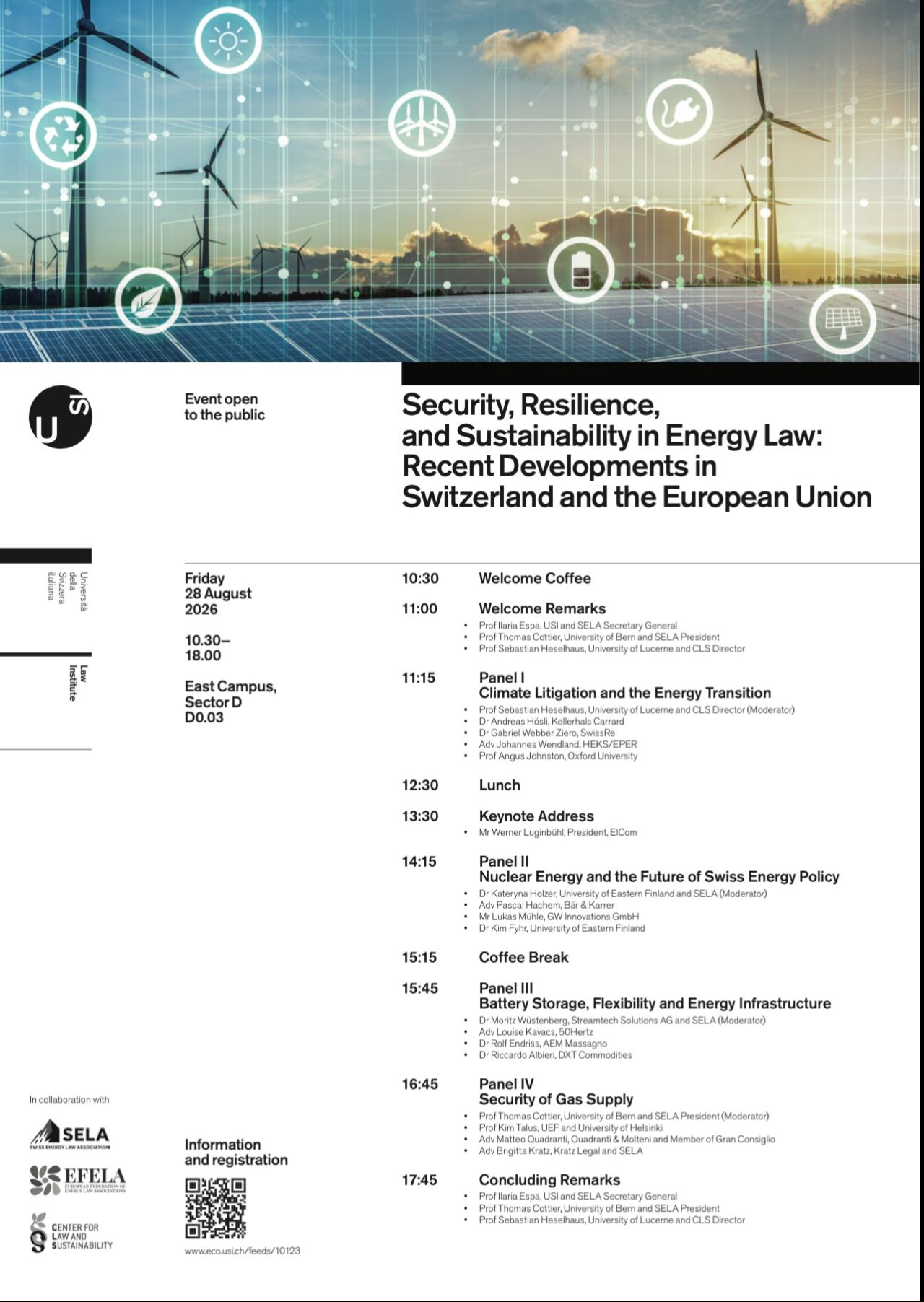
ANNUAL WORKSHOP 2026: 𝗦𝗲𝗰𝘂𝗿𝗶𝘁𝘆, 𝗥𝗲𝘀𝗶𝗹𝗶𝗲𝗻𝗰𝗲, 𝗮𝗻𝗱 𝗦𝘂𝘀𝘁𝗮𝗶𝗻𝗮𝗯𝗶𝗹𝗶𝘁𝘆 𝗶𝗻 𝗘𝗻𝗲𝗿𝗴𝘆 𝗟𝗮𝘄

The Swiss Energy Law Association is pleased to announce its upcoming conference, organised in collaboration with and hosted by the USI Università della Svizzera italiana:

𝗦𝗲𝗰𝘂𝗿𝗶𝘁𝘆, 𝗥𝗲𝘀𝗶𝗹𝗶𝗲𝗻𝗰𝗲, 𝗮𝗻𝗱 𝗦𝘂𝘀𝘁𝗮𝗶𝗻𝗮𝗯𝗶𝗹𝗶𝘁𝘆 𝗶𝗻 𝗘𝗻𝗲𝗿𝗴𝘆 𝗟𝗮𝘄
𝘙𝘦𝘤𝘦𝘯𝘵 𝘋𝘦𝘷𝘦𝘭𝘰𝘱𝘮𝘦𝘯𝘵𝘴 𝘪𝘯 𝘚𝘸𝘪𝘵𝘻𝘦𝘳𝘭𝘢𝘯𝘥 𝘢𝘯𝘥 𝘵𝘩𝘦 𝘌𝘶𝘳𝘰𝘱𝘦𝘢𝘯 𝘜𝘯𝘪𝘰𝘯

📅 Friday, 28 August 2026
🕥 10:30-18:00
📍 USI East Campus, Sector D, Room D0.03, Lugano – USI Università della Svizzera italiana
🎟️ Open to the public

The conference will open with welcome remarks by:
Prof. Ilaria Espa – USI Università della Svizzera italiana and Secretary General of the Swiss Energy Law Association
Prof. Thomas Cottier – University of Bern of Bern and President of the Swiss Energy Law Association
Prof. Sebastian Heselhaus – University of Lucerne and Director of the Center for Climate Politics, Economics and Law (C-CPEL) – Universität Luzern

𝗣𝗮𝗻𝗲𝗹 𝗜 – 𝗖𝗹𝗶𝗺𝗮𝘁𝗲 𝗟𝗶𝘁𝗶𝗴𝗮𝘁𝗶𝗼𝗻 𝗮𝗻𝗱 𝘁𝗵𝗲 𝗘𝗻𝗲𝗿𝗴𝘆 𝗧𝗿𝗮𝗻𝘀𝗶𝘁𝗶𝗼𝗻
Moderated by Prof. Sebastian Heselhaus, will feature:
– Dr. Andreas Hösli – Kellerhals Carrard
– Dr Gabriel Webber Ziero – Swiss Re
– Johannes Wendland, Attorney-at-Law – HEKS/EPER (Swiss Church Aid)
– Prof. Angus Johnston – University of Oxford

𝗞𝗲𝘆𝗻𝗼𝘁𝗲 𝗔𝗱𝗱𝗿𝗲𝘀𝘀
We are honoured to welcome Werner Luginbühl, President of the Swiss Federal Electricity Commission, ElCom, who will deliver the keynote address.

𝗣𝗮𝗻𝗲𝗹 𝗜𝗜 – 𝗡𝘂𝗰𝗹𝗲𝗮𝗿 𝗘𝗻𝗲𝗿𝗴𝘆 𝗮𝗻𝗱 𝘁𝗵𝗲 𝗙𝘂𝘁𝘂𝗿𝗲 𝗼𝗳 𝗦𝘄𝗶𝘀𝘀 𝗘𝗻𝗲𝗿𝗴𝘆 𝗣𝗼𝗹𝗶𝗰𝘆
Moderated by Dr Kateryna Holzer, University of Eastern Finland and Swiss Energy Law Association, and will feature:
– Dr. Pascal Hachem , Attorney-at-Law – Bär & Karrer
– Mr Lukas Mühle – GW Innovations GmbH
– Dr Kim Fyhr – University of Eastern Finland

𝗣𝗮𝗻𝗲𝗹 𝗜𝗜𝗜 – 𝗕𝗮𝘁𝘁𝗲𝗿𝘆 𝗦𝘁𝗼𝗿𝗮𝗴𝗲, 𝗙𝗹𝗲𝘅𝗶𝗯𝗶𝗹𝗶𝘁𝘆 𝗮𝗻𝗱 𝗘𝗻𝗲𝗿𝗴𝘆 𝗜𝗻𝗳𝗿𝗮𝘀𝘁𝗿𝘂𝗰𝘁𝘂𝗿𝗲
Moderated by Dr Moritz Wüstenberg, Streamtech Solutions AG and Swiss Energy Law Association, and will feature:
– Dr. Dr. Louise Kavacs, Attorney-at-Law – 50Hertz Transmission GmbH
– Rolf Endriss – Azienda Elettrica di Massagno (AEM) SA
– Dr Riccardo Albieri – DXT Commodities

𝗣𝗮𝗻𝗲𝗹 𝗜𝗩 – 𝗦𝗲𝗰𝘂𝗿𝗶𝘁𝘆 𝗼𝗳 𝗚𝗮𝘀 𝗦𝘂𝗽𝗽𝗹𝘆
Moderated by Prof. Thomas Cottier, and will feature:
– Prof. Kim Talus – University of Eastern Finland and University of Helsinki
– Matteo Quadranti, Attorney-at-Law – Studio Legale e Notarile Quadranti – Molteni and Member of the Grand Council of the Canton of Ticino
– Brigitta Kratz, Attorney-at-Law – 𝗞𝗿𝗮𝘁𝘇 𝗟𝗲𝗴𝗮𝗹 and Swiss Energy Law Association

Organised in collaboration with the EFELA – European Federation of Energy Law Associations and the Center for Climate Politics, Economics and Law (C-CPEL) – Universität Luzern

A Japanese investor takes Switzerland to ICSID: What we know so far about Osumi v. Swiss Confederation, and why it matters

By Katarina Mirkovic

On 7 January 2026, the Secretary-General of the International Centre for Settlement of Investment Disputes (ICSID) registered a request for arbitration filed by Hiroshi Osumi (Japan) against the Swiss Confederation (ICSID Case No. ARB/26/1). Under ICSID practice, registration is an institutional act by the Secretariat confirming the formal receivability of the request. It does not prejudge jurisdiction, nor any assessment of breach, causation, or quantum. Conceptually, it marks the shift from a pre-dispute posture to a structured adversarial process in which jurisdiction and admissibility typically crystallise before the merits.[1]


Background of the dispute: why “debt instruments” and “finance” point to Credit Suisse AT1

The newly registered case has been associated with the Credit Suisse rescue and, in particular, with FINMA’s March 2023 decision to write down CHF 16.5 billion of Additional Tier 1 (AT1) instruments to zero in the context of the UBS takeover.[2] If the dispute indeed turns on that write-down, the central issue is not merely one of economic loss, but of legal characterisation: how an emergency resolution measure adopted in the interest of financial stability interfaces with treaty-based standards of investor protection.

Moreover, in October 2025, Switzerland’s Federal Administrative Court held that FINMA’s AT1 writeoff lacked a sufficient legal basis and seriously interfered with bondholders’ property rights, while leaving open what remedy would ultimately follow and noting the possibility of appeal.[3] While such a domestic legality finding is not dispositive in treaty arbitration, it may nonetheless inform the tribunal’s assessment of due process, transparency, reasonableness, and the surrounding regulatory context.


The legal hook: the Switzerland-Japan Economic Partnership Agreement and its ISDS clause

The claim is framed as a breach of the investment protections contained in the Agreement on Free Trade and Economic Partnership between Japan and the Swiss Confederation, in force since 1 September 2009.[4] From the perspective of consent, the treaty operates as the State’s standing offer to arbitrate, which a qualifying investor accepts by initiating proceedings; the arbitration agreement is thus formed by the interaction between treaty consent and the investor’s submission of the dispute.

Crucially, that Agreement contains an investor-state dispute settlement mechanism. Article 94 provides that if a dispute cannot be settled through consultations within six months, an investor may submit the dispute to ICSID arbitration, among other options, and it contains the familiar “consent” language by each Party to arbitration.[5] This matters because the consultation period and any accompanying admissibility conditions are not mere formalities: they structure the dispute temporally and may become jurisdictional or admissibility battlegrounds if contested.

The UNCTAD Investment Policy Hub also classifies the agreement as a treaty with investment provisions and links to the full text.[6]

So the jurisdictional architecture is not mysterious: the treaty itself furnishes a pathway to ICSID for qualifying investors.


What the “registration” tells us, and what it does not

Registration means the request has cleared a threshold set by the ICSID Secretariat and the case is now formally pending. It does not mean that:

  • the tribunal exists already (it still needs to be constituted),
  • jurisdiction is established (Switzerland may raise objections),
  • or that any compensation is due.

Put differently, the claimant has secured access to the procedural forum, but not yet to the adjudicatory competence of the tribunal. Jurisdiction remains to be established through the applicable treaty, the notion of “investment”, and the claimant’s standing as an investor.

But it does mean that Switzerland is now in the procedural posture of a respondent State in a live ICSID arbitration, with all the predictable consequences: counsel team, internal record gathering, and early strategy on jurisdiction, admissibility and merits framing.


Why the case is significant for Switzerland, even before we see the pleadings

There are at least four reasons this registration matters, even on sparse public information.

  • Switzerland is being tested as a respondent State in a finance-crisis decision
    Investment arbitration is often associated with infrastructure, energy assets, or classic expropriation scenarios. Here, the dispute appears anchored in a bank-resolution emergency and its treatment of capital instruments. That is a particularly sensitive category of dispute because it sits at the intersection of public stability measures and private investor loss allocation. In investment law, this is precisely where the most conceptually difficult cases arise: the tribunal must balance deference to legitimate regulatory objectives against the minimum content of investor protection, without converting the treaty into a general insurance scheme against macroeconomic shocks.
  • The treaty lever is not a BIT from the 1990s, but a modern FTA-style investment chapter

The Japan-Switzerland agreement is a broad economic partnership treaty with an investment chapter and an ISDS clause that expressly mentions ICSID.[7] This matters because these clauses often embed specific procedural filters (consultations, time limits, waiver logic) that can shape jurisdiction fights early. Accordingly, the dispute is likely to be shaped not only by substantive standards, but by the architecture of the treaty itself: definitions, scope clauses, fork-in-the-road or waiver mechanics (if applicable), and the sequencing of pre-arbitration steps.

  • Domestic litigation and international arbitration are moving in parallel
    The Swiss administrative-court finding of unlawfulness on the FINMA writeoff, and the broader global litigation around AT1 instruments, create a messy multi-forum environment. Treaty tribunals sometimes treat domestic decisions as factual context rather than dispositive law, but they are rarely irrelevant. Parallel proceedings do not predetermine the outcome, but they can shape argumentation on attribution, the reasonableness of regulatory conduct, and the investor’s legitimate expectations, as well as the tribunal’s approach to factual complexity.
  • “Debt instruments” claims are not theoretical anymore
    Law-firm and practitioner commentary has been openly discussing treaty routes for Credit Suisse AT1 holders for some time, signalling that the pipeline of claims is not limited to a single filing.[8] More broadly, the case illustrates the progressive ‘financialisation’ of investment arbitration: disputes increasingly concern regulatory choices affecting financial instruments, rather than the classic paradigm of physical asset takings.


What happens next

Procedurally, the next visible milestones tend to be:

  • constitution of the arbitral tribunal,
  • any early jurisdictional objections by Switzerland,
  • and potentially publication of redacted procedural decisions, depending on transparency choices.

At the moment, the most concrete takeaway is this: the claim has moved from a contingent risk into a formally pending ICSID proceeding. It is now on the ICSID docket.

The legally prudent reading remains modest: registration confirms procedural viability, not substantive responsibility. Still, once registered, a case typically requires immediate action on document preservation, internal fact mapping, and early jurisdictional strategy.

Update (October 2026)

Since this note was first written, the proceeding has moved well beyond registration. The arbitral tribunal was constituted on 21 May 2026: it is presided over by Marinn Carlson, appointed by the parties, and composed of Peter Turner KC, appointed by the claimant, and Gabriel Bottini, appointed by Switzerland, with Geraldine R. Fischer acting as Secretary of the Tribunal, and the first session was held on 29 June 2026.[9] On 10 July 2026 the Tribunal issued Procedural Order No. 1, which confirms that the proceeding is governed by the ICSID Arbitration Rules in force as of 1 July 2022 and which, at this early stage, denied the claimant’s request, formulated in its Request for Arbitration of 12 December 2025, for an order requiring Switzerland to produce 592 documents referenced in, but not made public with, the report of the Parliamentary Commission of Inquiry established by the Federal Assembly, dated 17 December 2024; the denial is, however, without prejudice to the claimant renewing the request in the document production phase, once both parties have set out their full factual and legal positions.[10] On the same day the Tribunal issued Procedural Order No. 2 on transparency and confidentiality, under which the parties consent to the publication of the award by ICSID with agreed redactions, whereas hearings are not open to the public, the parties’ written submissions are published only if a party seeks the publication of its own main pleadings, and supporting documents (exhibits, legal authorities, witness statements and expert reports) are not published at all.[11]

The procedural record also lends support to the connection with the Credit Suisse rescue suggested above, although the published orders do not mention the AT1 instruments by name: ICSID records the subject of the dispute as “debt instruments” in the finance sector, the claim rests on the 2009 Agreement on Free Trade and Economic Partnership between Japan and the Swiss Confederation, under whose Article 94(10) the procedural timetable expressly envisages a possible submission by Japan as the non-disputing Party, and the parliamentary report on which the claimant relies is the one in which the Commission of Inquiry examined the conduct of the authorities in the context of the emergency takeover of Credit Suisse.[12] On the domestic front, FINMA announced on 15 October 2025 that it would appeal the Federal Administrative Court’s partial decision to the Federal Supreme Court.[13] Finally, on 3 August 2026 Switzerland filed a request for security for costs and a request concerning advances on costs, on which the parties exchanged further observations until 7 September 2026.[14]

[1] ICSID registration reported via Italaw, “Registration of the Request for Arbitration”, 7 January 2026. https://italaw.com/cases/14438

[2] Reuters, 4 December 2025, describing Japanese investors initiating an ICSID complaint over the AT1 wipeout.

[3] Swiss court rules $20 billion Credit Suisse bond write-off unlawful, by Dave Graham, John Revill and Oliver Hirt, Reuters, 14 October 2025

[4] Japanese investors sue Switzerland over Credit Suisse’s AT1 write-down, law firm says, by Reuters, 4 December 2025.

[5] Japan-Switzerland FTEPA text, Article 94 on settlement of investment disputes, hosted by SECO and Japan’s MOFA.

[6] UNCTAD IIA entry for Japan-Switzerland EPA (2009)

[7] SECO and MOFA treaty text; Article 94.

[8] Financial services blog: The Write down of Credit Suisse AT1 Bonds Keep the Courts Busy, by Kurt Blickenstorfer, Bratschi blog https://www.bratschi.ch/en/publikationen/financial-services-blog-the-write-down-of-credit-suisse-at1-bonds-keep-the-courts-busy

[9] ICSID, Case Details, Hiroshi Osumi v. Swiss Confederation (ICSID Case No. ARB/26/1), https://icsid.worldbank.org/cases/case-database/case-detail?CaseNo=ARB/26/1, accessed 5 October 2026; Procedural Order No. 1, 10 July 2026, §2.1.

[10] Hiroshi Osumi v. Swiss Confederation, ICSID Case No. ARB/26/1, Procedural Order No. 1, 10 July 2026, §§1.1 and 15.9–15.14, https://icsidfiles.worldbank.org/icsid/ICSIDBLOBS/OnlineAwards/C13188/DS21811_En.pdf, also available on Italaw, https://italaw.com/cases/14438.

[11] Hiroshi Osumi v. Swiss Confederation, ICSID Case No. ARB/26/1, Procedural Order No. 2 on Transparency and Confidentiality, 10 July 2026, §§12–17, https://icsidfiles.worldbank.org/icsid/ICSIDBLOBS/OnlineAwards/C13188/DS21872_En.pdf.

[12] ICSID, Case Details, see note 9; Procedural Order No. 1, see note 10, §15.9 and footnote 4, and Annex B; Swiss Parliament, “Lessons from the Credit Suisse crisis”, press release, 20 December 2024, https://www.parlament.ch/press-releases/Pages/mm-puk-2024-20-12.aspx?lang=1033.

[13] FINMA, “FINMA to appeal partial decision of the Federal Administrative Court concerning AT1”, 15 October 2025, https://www.finma.ch/en/news/2025/10/20251015-meldung-bvger-at1/.

[14] ICSID, Case Details, see note 9, procedural details of 3, 24 and 31 August and 7 September 2026.

ENERGY LUNCH / SELA Webinar: EU and Swiss Hydrogen Law and Policy – Recent Developments

The Swiss Energy Law Association is pleased to invite you to its next SELA Energy Lunch, dedicated to recent developments in hydrogen law and policy in the European Union and Switzerland.

Hydrogen is becoming one of the key regulatory questions of the energy transition. Beyond infrastructure and technology, its development raises increasingly concrete legal issues, including market design, certification, cross-border trade, sustainability criteria, security of supply, and the comparative assessment of EU and Swiss regulatory choices.

The event will take place online and will offer an opportunity to discuss these developments with two leading experts in the field.

Event details

Title: EU and Swiss Hydrogen Law and Policy: Recent Developments
Date: 21 May 2026
Time: 12:30 – 13:30 CET
Format: Online via Zoom

Registration

Participation is free, but registration is required. Please note that the Zoom link is personal and will be sent only after registration.

Register here:
https://unige.zoom.us/meeting/register/bPnYaJIMSsaOZpAMfyeHZ9A

Speakers

Prof. Kim Talus
Kim Talus is Founding Partner at Energy & Regulation Partners in Zug, where his work focuses on EU energy law and regulation. He is also Professor of European Energy Law at UEF Law School and Professor of Energy Law at the University of Helsinki. He is an observing member of the European Federation of Energy Law Associations.

Prof. Sirja-Leena Penttinen
Sirja-Leena Penttinen is a tenured Associate Professor of Law and Sustainability Transitions at the Faculty of Law, University of Lapland. Her research focuses on the legal frameworks surrounding the green energy transition. Her ongoing research projects examine regulatory approaches to critical raw materials, hydrogen and other emerging technologies. Her interests span energy law, sustainability transitions, and the regulatory challenges of implementing new energy technologies.

We look forward to an engaging discussion on a rapidly evolving area of energy law.

At the threshold of climate harm: The Zug Interim Decision in Pari Island v. Holcim and the Procedural Politics of Swiss Civil Justice

By Katarina Mirkovic

On 17 December 2025, the Cantonal Court of Zug issued an interim ruling (Zwischenentscheid) in case A1 2023 9, dispatched to the parties on 18 December and made public on 22 December 2025, holding that a climate-related civil claim brought by four residents of Pari Island, Indonesia, against Holcim AG satisfies the procedural requirements to be heard. The ruling does not address liability. It addresses something prior, and in many ways more consequential: whether the claim is framed in a manner that allows a Swiss civil court, in principle, to adjudicate and enforce it.[1]

That distinction matters. What is decided here is not responsibility for climate harm, but access to adjudication. Holcim has announced that it will challenge the decision on appeal, and Swiss media reported the same day that the company intends to take the case to the next instance. What remains, however, is a reasoned judicial statement that climate-related harm, when pleaded in private-law terms, does not dissolve into politics at the courthouse door.[2]


1.   What is this case, in plain terms, and why it is not “just politics”

The narrative underpinning the case is simple. The plaintiffs live on Pari Island and allege that rising sea levels have led to increasingly frequent flooding, affecting their property, daily life, and long-term security. They argue that Holcim contributes to that harm through greenhouse-gas emissions associated with its cement business, and that this contribution can ground civil-law remedies.[3]

The court does not deny the political dimension of climate change. What it does deny is that political salience, as such, deprives a claim of its civil character. Where plaintiffs plead an infringement of private-law rights, seek recognised civil remedies, and assert an individual legal interest worthy of protection, the dispute remains justiciable. The court makes this point explicitly, anchoring it in Switzerland’s constitutional guarantee of access to a judge.[4]

Climate harm is not treated as an abstract policy concern, but as something capable of being translated into procedural justiciability under Swiss civil litigation rules. The question is not whether climate change is political. It is whether politics exhausts the legal meaning of the claim. The court’s answer is no.


2. The record matters: what is actually in the court file (timeline and procedural steps)

Given the attention the case has attracted in public commentary, it is worth fixing what is not speculation. This is not a claim improvised for media effect.

Conciliation proceedings were formally initiated on 11 July 2022 before the Peace Court in Zug. Authorisation to sue was granted on 6 October 2022, with conciliation costs of CHF 600 charged to the claimants.[5] The civil action was filed on 30 January 2023.[6] On 30 June 2023,[7] the reporting judge limited the proceedings to questions of admissibility. The main hearing on those issues took place on 3 September 2025,[8] following two rounds of written submissions by each side and additional document production by Holcim. These steps are also reflected in public materials released by HEKS.[9]

This procedural density matters. It signals that the court is not responding to a symbolic dispute, but to a structured civil file that has been narrowed, argued, and documented over time. What is at stake is not a press release, but a case.


3. What the plaintiffs actually asked for (numbers, baselines, enforcement tools)

The relief sought is neither abstract nor rhetorical. The core request is an injunction (Unterlassungsbegehren), backed by an order fine of CHF 1,000 per day and a reference to Article 292 of the Swiss Criminal Code. It is pleaded on a group-wide basis, expressly covering Scope 1, 2, and 3 emissions.[10]

The requested emissions pathway is articulated with year-by-year milestones from 2025 to 2040, using 2019 as the baseline, and is supported by pleaded baseline emissions data in both absolute and intensity terms. Monetary claims are itemised in Indonesian Rupiah and include contributions for flood-protection measures on Pari Island, additional amounts for alleged present and future damage, and claims for moral satisfaction, with interest running from 11 July 2022.[11]

This is where the court answers the objection of vagueness with a practical observation: this is not a generic appeal to climate responsibility. It is a quantified claim, framed with enforcement mechanics.[12]


4. The three admissibility hurdles Holcim raised, and how the court dealt with them

Holcim’s procedural objections can be stated without rhetoric: wrong forum, wrong plaintiffs, wrong remedy.


4.1 Forum: “civil courts are not the place for global emissions”

On forum, the court’s response is anchored in civil procedure. Where a claim is pleaded in private-law terms and seeks private-law remedies, it falls within the jurisdiction of the civil courts, even if it arises against a globally charged factual background. This is why the decision is captioned as concerning protection of personality rights and claims for relief (Schutz der Persönlichkeit und Forderung).[13]


4.2 Standing and legal interest: “their interest is not personal enough”

On standing and legal interest, the court emphasises the requirement of a concrete Rechtsschutzinteresse.[14] What is notable is its explicit reliance on Article 29a of the Federal Constitution. The absence of broader societal implications is not the test. What matters is whether the plaintiffs plausibly assert an individual legal position of sufficient intensity.[15]


4.3 Determinacy: “you cannot enforce this, and it drags in subsidiaries”

On determinacy, the court adopts a governance-oriented lens. It notes that the pleaded baselines and scope distinctions allow supervision of compliance. It further relies on documents in the file indicating that Holcim’s board approves group-wide climate targets and is responsible for climate-related risks.[16] On that basis, the parent’s participation in group emissions is not treated as conceptually implausible at the admissibility stage. Questions of substantive liability, including group responsibility and factual control, are reserved for the merits.


This is the technical core of the ruling. The court does not endorse liability. It holds that the claim is structured in a way that allows liability to be assessed later.

5. Why Swiss companies should care, even if they are not cement producers

The practical signal is not that climate litigation is imminent for all Swiss companies. It is that Swiss procedural law is institutionally ready to host it. The significance of the Zug decision lies less in any substantive view on climate responsibility than in its procedural posture: admissibility is no longer a hypothetical debate conducted in memos and conference panels. A reasoned interim ruling has now stated, in a concrete file, that a climate-related claim can be pleaded in private-law terms with sufficient structure to be heard.[17]

That shift should matter to corporate defendants and in-house counsel even outside high-emissions sectors. Once the threshold is crossed, the dispute ceases to be a question of “whether courts will entertain this at all” and becomes a question of litigation management: of evidence, narrative, causation theories, remedies, and, ultimately, enforceability. In that sense, the court’s focus on determinacy is not technical trivia. It is an instruction on what plaintiffs must do to get in, and what defendants must anticipate: quantified baselines, pleaded milestones, and enforcement mechanics capable of judicial supervision.[18]

The decision also signals that corporate climate governance is not merely reputational content. Board-level targets, risk oversight statements, and group-wide climate strategies can become litigation scaffolding. Not because a court treats disclosure as a confession of liability, but because it uses internal governance material to make procedural judgments about control, participation, and the feasibility of the requested remedy. Companies should therefore read the case as a reminder that “governance” has a double life: it reassures markets and regulators, but it also creates an evidentiary surface that can be mobilised in court.[19]

Finally, the instinct to categorise climate claims as “political questions” is weakening. The Zug court does not deny the political dimensions of climate change. It treats them as background, not as a jurisdictional veto. This places Switzerland within a broader international pattern in which courts increasingly accept that private-law climate claims may be justiciable even when they interact with public policy, precisely because the claims are framed as infringements of individual legal positions and are pleaded with remedies that a judge can, at least in principle, enforce.

A useful analogue is Lliuya v. RWE before the Higher Regional Court of Hamm (Germany): not because the facts are identical, but because it clarifies what follows once a court agrees to hear a climate-harm claim against a major emitter. There, a Peruvian claimant sought a proportional contribution to adaptation measures (flood-protection works) on the theory that RWE’s historical emissions formed a measurable share of the relevant climate risk. The case makes explicit what climate tort litigation tends to become after admissibility: a contest over proof, in which risk, causation, and attribution are translated into legal standards of evidence. Zug, in that sense, is a threshold decision; Lliuya is a reminder of what the threshold leads to.[20]

The message, then, is not that liability has been found. It is that the procedural door is open, and that the arguments that follow will be fought on the terrain of private law rather than dismissed at the threshold.[21]


6. What happens next

The court classifies its ruling as a Zwischenentscheid for a reason. If the appellate court disagrees on admissibility, the case may end at the threshold.[22] If the decision stands, the dispute will move into the merits phase, where the familiar but difficult questions will arise: causation, wrongfulness, fault where relevant, quantification, and the proportionality of injunctive relief.

What the Zug court has decided is not how those questions should be answered. It has decided that they can, in principle, be asked.

Update (October 2026)

Holcim announced its intention to appeal as soon as the decision was made public, and the plaintiffs’ campaign reports that on 6 March 2026 the High Court of the Canton of Zug (Obergericht), like the Cantonal Court before it, granted the four plaintiffs legal aid, which indicates that the appeal proceedings are now pending before that court. As of 5 October 2026, no decision of the Obergericht on the appeal appears to have been made public, so that the interim ruling, however reasoned and significant, is not yet final, and the threshold question discussed above remains formally open until the appellate court has ruled on it.[23]

[1] Kantonsgericht Zug, “Entscheid des Kantonsgerichts Zug vom 17.12.2025 A1 2023 9”, title page and “betreffend Schutz der Persönlichkeit und Forderung (Prozessvoraussetzungen)”, pp. 1-2.

[2] SRF, “Gericht lässt Klimaklage zu”, 22.12.2025; ref.ch, 22.12.2025.

[3] Kantonsgericht Zug, A1 2023 9, “Sachverhalt”, para. 1, p. 4.

[4] Kantonsgericht Zug, A1 2023 9, section referencing Art. 29a BV, pp. 49-50.

[5] Kantonsgericht Zug, A1 2023 9, “Sachverhalt”, paras. 2-3, p. 4.

[6] Kantonsgericht Zug, A1 2023 9, “Sachverhalt”, para. 3, p. 4.

[7] Kantonsgericht Zug, A1 2023 9, “Sachverhalt”, para. 4, p. 4.

[8] Kantonsgericht Zug, A1 2023 9, “Sachverhalt”, para. 8, p. 5.

[9] HEKS/EPER, “Hauptverhandlung am 3. September”, media note.

[10] Kantonsgericht Zug, A1 2023 9, “Rechtsbegehren Kläger”, para. 1.1, p. 2.

[11] Kantonsgericht Zug, A1 2023 9, “Rechtsbegehren Kläger”, para. 1.1, pp. 2-3.

[12] Kantonsgericht Zug, A1 2023 9, “Rechtsbegehren Kläger”, paras. 2–5, pp. 2–3

[13] Kantonsgericht Zug, A1 2023 9, cover and section on Art. 59 ZPO, pp. 4-5; ref.ch report, 22.12.2025; SRF report, 22.12.2025.

[14] Kantonsgericht Zug, A1 2023 9, references to Art. 59 ZPO and discussion leading into the “besondere Betroffenheit”, pp. 4-5 and later cross-reference, p. 50.

[15] Kantonsgericht Zug, A1 2023 9, Art. 29a BV discussion, pp. 49-50.

[16] Kantonsgericht Zug, A1 2023 9, section 6.5.1, p. 48.

[17] Kantonsgericht Zug, A1 2023 9, dispositive reasoning “Auf die Klage ist demnach einzutreten”, p. 49 and continuation.

[18] Kantonsgericht Zug, A1 2023 9, section 6.5.2, p. 49, reference to “act. 1/25 S. 88”.

[19] Reuters, 22.12.2025; Business & Human Rights Resource Centre compilation, 22.12.2025 https://www.reuters.com/sustainability/cop/swiss-court-admits-indonesia-islanders-climate-case-against-holcim-2025-12-22/

[20] Oberlandesgericht Hamm. (2025, May 28). Klage eines peruanischen Bergführers gegen RWE erfolglos – Urteil im Verfahren Lliuya gegen RWE (Az. 5 U 15/17).

[21] Reuters, 22.12.2025; Business & Human Rights Resource Centre compilation, 22.12.2025 https://www.reuters.com/sustainability/cop/swiss-court-admits-indonesia-islanders-climate-case-against-holcim-2025-12-22/

[22] Kantonsgericht Zug, A1 2023 9, section 9.2, pp. 51-52.

[23] Call for Climate Justice (campaign of HEKS/EPER and partner organisations), “Timeline”, entries of 17 December 2025 and 6 March 2026, https://callforclimatejustice.org/en/the-case/timeline/, accessed 5 October 2026; on the appealability of the interim ruling, Kantonsgericht Zug, A1 2023 9, dispositive part, para. 3, p. 52.

ENERGY LUNCH / SELA Webinar: The Evolution of Power Purchase Agreements in a Comparative Perspective: The Italian and the Swiss Experiences

On 16 April, SELA hosted the webinar “The Evolution of Power Purchase Agreements in a Comparative Perspective: The Italian and the Swiss Experiences”, as part of its Energy Lunch series.

The webinar featured two speakers who addressed the topic of Power Purchase Agreements from complementary perspectives.

Dr. Brigitta Kratz focused on the Swiss regulatory framework applicable to PPAs. Her presentation examined recent and forthcoming developments in Swiss energy law, including the revised rules on basic supply, the new federal framework on supervision and transparency in wholesale energy markets, the reform of the Swiss balancing energy market, and current issues relating to guarantees of origin.

Avv. Lorenzo Parola addressed corporate PPAs from a comparative and contractual standpoint, with particular attention to the distinction between physical and virtual models, the main PPA structures currently used in practice, the principal risk allocation issues, and the key contractual provisions typically negotiated in these agreements.

The presentation slides are available in attachment to this page.

BKratz_SELA Webinar LParola_PPA_SELA_16.4

LParola_PPA_SELA_16.4

Energy lunch: The evolution of Power Purchase Agreements in a comparative perspective: the Italian and the Swiss experiences

The PPA is no longer a contract you “close” – it’s a risk machine you engineer.

Join Swiss Energy Law Association (SELA) for our first Energy Lunch of the year on “The evolution of Power Purchase Agreements in a comparative perspective: the Italian and the Swiss experiences”.

As corporate PPAs evolve, so do the contractual tools used to allocate price, volume, balancing, curtailment and credit risk, and to keep projects financeable and executable in practice. This session will offer a comparative discussion of how PPA structures and market practice are developing in Italy and Switzerland, with a focus on the clauses that increasingly carry the deal.

Speakers: Brigitta Kratz (Kratz Legal) and Lorenzo Parola (Parola Associati)
Moderated by: Ilaria Espa

📅 Thursday, 16 April 2026
🕛 12:30-13:30 (CET)

Registration link: https://lnkd.in/dwQ8MGXf

hashtagEnergyLaw hashtagPPA hashtagRenewables hashtagPowerMarkets hashtagContracts hashtagSwitzerland hashtagItaly

SELA Annual Meeting 2025

We would like to extend a warm thank you to all speakers, moderators and participants for their contributions to the SELA Annual Meeting 2025, held on 27 November at the Università della Svizzera italiana (USI) in Lugano. The event, jointly organised by SELA, USI and the La Suisse en Europe Association (ASE), focused on “The EU–CH Electricity Agreement: Implications for Switzerland.”

Through a dialogue among lawyers, academics and technical experts, the meeting unpacked the key legal, institutional and operational questions raised by the prospective implementation of the Agreement, set against the broader evolution of EU-Swiss relations. Opening remarks by Prof Dr Thomas Cottier and Prof Dr Ilaria Espa highlighted why electricity has become central to wider debates on sovereignty, interdependence, security of supply and market design, and why SELA remains a key forum for open stakeholder exchange. EFELA’s Secretary General, Adv Marinella De Focatiis, also stressed the value of anchoring the Swiss discussion within the wider EFELA network.

The first panel situated the Agreement in the European context and clarified core issues of market integration, dynamic alignment and practical misunderstandings, including the implications for cross-border capacity, market coupling, crisis coordination, and the contours of state-aid and dispute-settlement discussions. It was confirmed that the Agreement respects cantonal water rights and does not require EU-wide tenders for future concessions.

The second panel moved to system operations, reserves and contracts: speakers discussed how renewables are reshaping grid management, why predictable transmission capacity matters, how winter reserves may evolve under a more integrated framework, and what the Agreement could mean for Swiss PPAs and risk allocation.

The final panel focused on liberalisation, trading and commercial operations, addressing consumer protection, utility transformation (including risk management and IT systems), and the compliance implications of REMIT-like transparency and market integrity rules for Swiss-based trading activity.

Overall, the discussions did not aim to produce a single “SELA view”, but to clarify the main questions Switzerland will face if the Agreement enters into force. Several contributions pointed to benefits for security of supply, grid stability and investment. At the same time, speakers underlined that a structured framework would require coherent domestic choices. One conclusion was clear: without an agreement, securing stable supplies, especially in winter, is likely to remain difficult and costlier, and cross-border trading from Switzerland more constrained.

Materials:

Brauchli_Generation, Supply and Transmission of Electricity

Cottier_SELA Panel 1 TC

Heselhaus_Thoma_Presentation_SH_ST_final

Hachem_20251127 Energy Law Conference Lugano

Endriss_SELA USI Lugano 27.11.2025 RE notes

Endriss_AEM USI SELA 2025

Parola_Slide SELA_27.11.25

SELA Annual Meeting 2025 – Event / The EU-CH Electricity Agreement: implications for Switzlerand

How could a future EU-CH electricity agreement influence Switzerland’s electricity system and its interaction with neighbouring markets? What might change for cross-border flows, grid stability and winter security of supply? These are some of the questions that will be at the centre of the Swiss Energy Law Association’s 2025 annual conference: The EU-CH Electricity Agreement: […]

Stability without immobilisation: Renegotiation, regulatory change, and contractual governance in the energy transition

By Katarina Mirkovic

The energy transition does not “disrupt” long-term energy contracts so much as it renders visible what they have always contained: an uneasy bargain between expectations of stability and the inevitability of regulatory evolution. If stability is treated as the immobilisation of the legal framework, it will predictably fail, and it will fail in the familiar way: by translating political disagreement into compensable loss. This article proposes a different view. Stability, here, is the preservation of the bargain through legally structured adjustment. On that basis, it revisits stabilization clauses as techniques of risk allocation and valuation, and only exceptionally as devices that could plausibly constrain regulatory change. It then argues that investor-state arbitration, whatever its virtues in allocating responsibility ex post, is poorly equipped to manage contractual equilibrium under accelerated “change in law”. The alternative explored is contractual: dispute avoidance through Dispute Avoidance and Adjudication Boards (DAABs), understood as standing, project-embedded decision-makers capable of swift interim determinations while performance continues. The conclusion draws drafting implications for climate-aligned energy contracting.


1.    Introduction

The global energy transition is often described as a shift in technology and infrastructure. For long-term energy contracts, it is more usefully read as juridical: a redefinition of the regulatory perimeter within which performance is expected to remain “stable”.[1] Anchored in multilateral commitments such as the Paris Agreement and the United Nations Sustainable Development Goals (notably SDG 13),[2] the transition places legal frameworks under a particular kind of pressure.[3] It is not merely that regulation is changing. It is that change has become programmatic. Under the Paris Agreement, Parties are expected to communicate nationally determined contributions on a recurring cycle, and the regime is coupled with a periodic global stocktake that recalibrates ambition and, in practice, drives successive rounds of domestic regulatory tightening. For contracting parties, “change in law” is therefore less an episodic shock than a foreseeable rhythm of governance. Ex ante mechanisms for adjustment become, in that setting, not a matter of convenience, but of contractual survivability.

A familiar tension sits at the centre of this development. On the one hand, long-term projects continue to depend on the grammar of stability: pacta sunt servanda, the doctrine of acquired rights, and the contested promise of the internationalisation of State contracts. On the other hand, the same projects are performed in a regulatory environment increasingly structured by climate duties, administrative enforcement, and the prospect of litigation. The point is not that contracts have suddenly become fragile. The point is that they have always been political artefacts, and the transition merely makes that politics harder to postpone.[4]

This is particularly visible in extractive industries. Long-term petroleum and gas agreements have long served as more than legal bargains over price and performance. They are instruments through which risk, public revenue, and regulatory authority are organised across time. Their structural mutability is therefore not an anomaly. Regulatory change and shifting public interests are not external accidents that “interfere” with a neutral economic relationship. They are foreseeable forces that periodically test the allocation of risk reflected in the bargain, and, when the test is sufficiently intense, activate renegotiation.

This article examines the legal architecture of renegotiation in international energy contracting, treating dispute resolution not as a merely ex post forum, but as part of the governance design that keeps performance viable under accelerated regulatory change. In that perspective, the legal problem is not whether stability should matter. It is how stability is produced. If stability is treated as the immobilisation of the legal framework, it will predictably fail, and it will fail in the familiar way: by translating political disagreement into compensable loss.

In this article, “dynamic stability” denotes stability through orderly legal avenues for adjustment:[5] clauses and procedures that identify relevant change, impose duties of cooperation and good faith, and channel disagreement into staged processes so that performance can continue while the parties restore contractual equilibrium.[6] Yet the claim is not only doctrinal. Stability is not merely a function of drafting or formal renegotiation.[7] It also depends on whether parties can sustain cooperation, reciprocity, and a workable sense of fairness over time, a practical dimension that becomes sharper as regulatory change accelerates and renegotiation moves from exception to background condition.[8]

The question that follows is often framed as a test of traditional contractual techniques: can stabilization clauses withstand the evolving regulatory frameworks required for decarbonisation? The question is not wrong, but it risks misdescribing what such clauses can plausibly do. To the extent that stabilization is presented as legal immobility, it will overpromise and underdeliver. What stabilization can more credibly secure is a distribution of regulatory risk and a method of valuation, not the suppression of regulatory evolution itself.

If that is right, the institutional focus shifts. The energy transition, by its nature, introduces new investments, new contracts, and inevitably, disputes. It also changes the temporal structure of those disputes: disagreement is increasingly likely to arise while performance must continue, and while the parties remain exposed to iterative rounds of regulation. Arbitration may allocate responsibility ex post, and it may do so with authority and finality. Yet it is poorly suited to the task that the transition most insistently generates: the ongoing management of contractual equilibrium under accelerated “change in law”. The alternative explored here is contractual and procedural. It is dispute avoidance through Dispute Avoidance and Adjudication Boards (DAABs), conceived as standing, project-embedded decision-makers capable of swift interim determinations while performance continues.[9] FIDIC has recently reinforced this orientation by publishing a practice note focused on dispute avoidance through dispute boards, a sign that users increasingly seek early intervention techniques before disagreements harden into late-stage, high-cost proceedings.

The article’s central submission is straightforward. Under energy-transition conditions, stability is secured through contractually pre-arranged adjustment, not through the pretence of legal immobility.


2.    Stabilization clauses: legal rigidity in the face of dynamic environmental imperatives

Stabilization clauses are often presented as the price of long-term investment in politically and legally uncertain environments. In capital-intensive sectors such as oil and gas, they have served as a credibility device: a way of reassuring investors that the regulatory perimeter of the project would not be re-written without consequence. The familiar shorthand is that such clauses “freeze” the applicable legal framework. Yet what matters is not the metaphor but the institutional function: stabilization promises to translate regulatory evolution into a manageable contractual event, rather than leaving it as an open-ended political risk.[10]

Stabilization is not a single technique but a family of techniques. At one end are freezing formulations, drafted to insulate the project from future legal change; at the other are economic equilibrium clauses, which proceed from the opposite premise: that change will occur, and that the question is how its economic impact will be valued, allocated, and, where appropriate, compensated. Even where stabilization cannot plausibly be read as disabling bona fide regulation pursued for legitimate public purposes, it may still operate as a bargaining and valuation device, shaping how regulatory change is priced ex post. Investment-law doctrine reinforces the practical point. The police powers doctrine and the “right to regulate” vocabulary tend to resist treating good-faith, non-discriminatory environmental measures as compensable takings. Stabilization language therefore rarely “stops” decarbonisation regulation. At most, it reorganises bargaining power, valuation, and the distribution of regulatory risk.

The limits of stabilization are often most visible where institutional capacity is weakest and the environmental stakes are highest. In such settings, disputes over pollution and clean-up obligations can be reframed as disputes over cost allocation: what appears, on paper, as environmental accountability becomes, in practice, an argument about “legitimate expenses” and regulatory gaps.[11] Stabilization clauses also function as interpretative anchors for domestic courts and tribunals, shaping how other contractual provisions are read and, indirectly, how responsibility is distributed. That interpretative weight may reassure investors and enhance a host State’s reputation as a contractual partner. Yet it also highlights an asymmetry built into the technique: credibility for investment may be purchased by making regulatory evolution more costly.[12] Stabilization language can therefore sit uneasily with the environmental reforms that climate obligations increasingly require.[13] The tension is not abstract. It is a recurring problem of translating public policy change into private entitlement. [14]

The extractive industries face a critical paradox as long-term contracts protected by stabilization clauses hinder states from adapting laws to meet climate goals without risking costly arbitration claims, a tension particularly acute in developing countries balancing investment needs with environmental obligations.[15] Indeed the rigidity of stabilization clauses protects investors but restricts states’ ability to implement necessary environmental laws, forcing them to choose between compensating investors for regulatory changes or facing costly arbitration claims, particularly under global climate commitments like the Paris Agreement.[16]

Considerations regarding stabilization clauses also encompass broader issues such as regulatory opportunism, information asymmetries, and the risks inherent in contractual inflexibility. These concerns become particularly salient within the context of the energy transition’s dynamic landscape, marked by rapid technological advancements, environmental shifts, and evolving policies.[17]

The discourse surrounding stabilization clauses in the context of energy transition is further enriched by contributions from scholars like S.N. Obulor,[18] who emphasizes the multifaceted nature of this transition, particularly in developing countries in the Global South, notably Sub-Saharan Africa. Obulor articulates that while the inevitability of energy transition is universally acknowledged, the breadth of its implications (spanning opportunities, challenges, and uncertainties) remains insufficiently explored.[19] Moreover, as noted by Z. A. Al Qurashi, the renegotiation of international petroleum agreements climaxes the struggle to balance investment protection with the evolving need for flexible environmental regulation, particularly in states heavily reliant on extractive industries.[20]


3.    Arbitration: balancing sovereignty and investor protections in energy disputes

Against this backdrop, arbitration is frequently presented as the natural forum for managing the disputes of the transition: neutral, enforceable, and insulated from domestic pressures that may be perceived as bias. Its appeal in cross-border, long-term projects is obvious. Yet the claim that arbitration can “balance” investor rights and regulatory evolution should be treated with care. Arbitration can allocate responsibility ex post, and it can do so with authority. But the more the transition turns regulatory change into a foreseeable rhythm, the more the dispute is likely to arise while performance must continue. What is at stake is therefore not merely whether arbitration can decide, but whether ex post adjudication can plausibly govern an ongoing contractual equilibrium.[21]

The regulatory impetus is increasingly reinforced by adjudication. The Grand Chamber judgment in Verein KlimaSeniorinnen Schweiz and Others v Switzerland shows how climate-related duties may be articulated in human-rights terms, with foreseeable consequences for the regulatory space within which energy contracts are performed. Beyond its symbolic weight, the judgment confirms that climate governance is increasingly framed as a matter of enforceable legal obligations. For long-term energy contracts, this matters because it makes regulatory tightening more foreseeable, and therefore harder to treat as a remote ‘political risk’ external to the contractual bargain.[22]

At the same time, the investment-protection environment is itself in flux. The European Union and Euratom have withdrawn from the Energy Charter Treaty, with effect from 28 June 2025, signalling a recalibration of the balance between investment protection and climate policy space.[23]

However, the limitations of arbitration must also be acknowledged. First, arbitration’s reputation as an effective means of resolving disputes has suffered.[24] While users still value its worldwide enforceability, avoidance of specific legal systems/national courts, and the general flexibility of proceedings,[25] arbitration is no longer perceived as cost and time-efficient.[26] One reason for this may be that arbitration has evolved into a form of “off-shore litigation”, where extensive document production and multiple rounds of submissions are common to facilitate the arbitrators’ adjudicative task.[27] In contrast, settlement efforts by a proactive tribunal are often seen as a significant way to increase efficiency in arbitration.[28] Users increasingly value integrating adjudicative and non-adjudicative mechanisms in arbitration, prioritizing opportunities for amicable dispute resolution even within adversarial processes.[29] One example is the growing use of multi-tier or escalation clauses, which require mandatory negotiations or mediation before arbitration can proceed.[30] Indeed, while arbitration is often viewed as a streamlined and efficient alternative to litigation, it is, by its nature, a reactive process. Moreover, disputes are only addressed after they have escalated, which can exacerbate tensions and result in costly, time-consuming proceedings. As environmental regulations intensify and decarbonization efforts accelerate, the number of arbitration cases related to regulatory changes is expected to rise, placing even more pressure on arbitral tribunals to find solutions that balance investor protections with public interest.[31] This trend is not merely quantitative: it amplifies the structural legitimacy problem of asking ex post adjudication to ‘solve’ what is, in substance, an ongoing allocation of regulatory adjustment burdens across the life of the project.

Arbitration remains, by design, a mechanism of ex post responsibility allocation. The contention that arbitrators can’t adapt the contract through rewriting is based on the traditional distinction between jurisdictional arbitration (adjudicating rights and duties based on past conduct, known as legal disputes) and contractual arbitration (shaping future relations through contract modification). It may decide who bears loss after disruption, but it is poorly suited to the day-to-day governance of a long-term project when the immediate need is to keep performance on track while the regulatory framework evolves.

Conceptually, the question of whether arbitrators could engage in settlement efforts concerns the extent and limits of their powers to conduct and structure arbitration proceedings.[32] The shifting contours of international arbitration reveal a profound entanglement with the challenges of renegotiating stabilization clauses, where the assertion of sovereign regulatory prerogatives collides with the inviolability of contractual commitments.[33] Arbitral tribunals are increasingly compelled not only to adjudicate but to recalibrate agreements to align with the imperatives of decarbonization, exposing the limits of reactive frameworks and underscoring the need for anticipatory mechanisms capable of navigating the legal tensions of the energy transition.[34]

Yet, even in arbitration regimes that authorize proactive settlement facilitation, such as the ‘type three’ frameworks, the risk of perceived bias remains ever-present. One party may argue that the settlement process has been tilted unfairly in favor of the other. To mitigate this risk and safeguard the tribunal’s integrity, it is prudent to secure a waiver from the parties, renouncing their right to challenge the arbitrator on the basis of the settlement activities.[35] This ensures that both parties are fully committed to the process and preemptively addresses any concerns of bias, thus allowing the arbitrator to operate with the flexibility needed to foster meaningful dialogue and resolution.


4.    Adaptive legal frameworks for the energy transition: harnessing the potential of Dispute Boards

If the problem is that disagreement increasingly arises while projects must continue to operate under iterative regulatory tightening, then a mechanism that arrives only after rupture is structurally mistimed. Dispute Boards, and in particular Dispute Avoidance and Adjudication Boards (DAABs), offer a different institutional logic: they embed interim decision-making into the life of the project.[36] Their promise is not that disputes disappear, but that disagreement can be processed without suspending performance, often through interim binding determinations under a “pay now, argue later” logic.[37] FIDIC’s recent emphasis on dispute avoidance through dispute boards, including its 2023 Practice Note,[38] reflects this orientation toward early intervention and project-embedded governance rather than late-stage adjudication.[39]

A salient feature is their interim binding effect, often summarised as “pay now, argue later”: compliance is expected in the first instance, while the dissatisfied party may later pursue arbitration or litigation. Boards may be constituted on a standing basis for the life of the project or appointed ad hoc; standing boards typically offer superior continuity, informational proximity, and genuine dispute-avoidance capacity.

What differentiates DAABs from stabilization clauses is their intrinsic adaptability, an essential characteristic in the energy sector, where regulatory, technological, and market fluctuations are both frequent and unpredictable. Stabilization clauses often exacerbate the rigidity that obstructs the adaptive evolution required for energy projects to remain viable.[40] In contrast, DAABs institutionalize continuous dialogue and implement proactive dispute resolution, allowing contractual frameworks to dynamically respond to emergent regulatory changes, such as the introduction of carbon pricing or emissions caps. The inherent inflexibility of static legal instruments, already highlighted by Al Faruque (2005), underscores the exigency for a more dynamic and responsive governance paradigm, of which DAABs are an expression.[41]

Rooted in Ian Macneil’s relational contract theory, DAABs ensure long-term energy agreements remain adaptable to regulatory, economic, and technological changes. [42] The concept of “open-endedness” underscores the necessity for long-term energy contracts to accommodate unforeseen developments adequately. This approach acknowledges that while certain risks may be foreseeable in principle, their specific manifestations and extents remain uncertain. Consequently, contractual frameworks should adopt a flexible stance, allowing for adjustments guided by principles of good faith and fairness.[43]

By providing continuous oversight and real-time dispute resolution, they minimize arbitration risks, preserve contractual integrity, and address the challenges of decarbonization-driven regulatory shifts,[44] as exemplified by FIDIC’s approach.[45]

The regular site visits and the close interaction with both parties enable DBs to offer opinions and guidance based on firsthand knowledge of the site. This approach aligns with the broader trend in international arbitration and adjudication, where tribunals are increasingly expected to integrate not just legal formalism but also a nuanced understanding of the practical realities of the sectors they adjudicate.

This institutional orientation is reflected in standard-setting practice. FIDIC has expressly promoted the dispute-avoidance function of dispute boards and issued dedicated guidance to foster best practice in their use.

This proposal suggests rethinking international energy contract governance, arguing that static frameworks like stabilization clauses are inadequate for the dynamic decarbonization landscape. Instead, Dispute Boards offer a flexible, real-time mechanism to align contracts with evolving regulations while preserving investment protections and supporting public policy goals.[46]

By integrating Dispute Boards into energy contracts, this approach proposes a pathway to addressing the legal, economic, and environmental complexities of the shift from fossil fuels to renewable energy. Such a framework might offer a more resilient legal architecture, balancing investor and state interests while fostering a transition that is legally sound, economically viable, and environmentally sustainable.[47] This possibility invites further examination of how legal structures can support the global energy transition in a more equitable and forward-looking manner.

If the objective is to preserve the bargain under foreseeable regulatory evolution, the drafting task is not to promise immobility, but to organise adjustment. Clauses should therefore do three things that standard stabilization language often leaves implicit: identify defined triggers for review, impose information and cooperation duties, and discipline renegotiation through timelines and escalation steps. In parallel, the contract should allocate interim decision-making to a project-embedded body capable of rapid determinations, so that performance is not held hostage to disagreement. The familiar objection is doctrinal. Renegotiation clauses risk being dismissed as mere “agreements to agree”, and thus treated as invalid or unenforceable in a number of jurisdictions. Yet that risk is not uniform.[48] English common law has tended to view agreements to negotiate as unenforceable, while many American jurisdictions, in more contemporary approaches, accept that duties to negotiate in good faith are not inherently void. The point, then, is not to romanticise renegotiation, but to draft it as an institution rather than an aspiration.

On this view, stabilization may be recast as calibrated protection of expectations: less a claim to legal immobility than a set of valuation and adjustment techniques (price review, equilibrium clauses, agreed formulas) through which the economic consequences of regulatory change are priced and allocated without denying the State’s regulatory prerogatives.

In the energy transition, the legal problem is not whether contracts should be stable, but how stability is legally produced. Treating stabilization as legal immobility overstates what such clauses can secure and understates the legitimacy, and the predictability, of regulatory evolution. A contractual architecture that combines calibrated stabilization, structured renegotiation, and DAAB-style dispute avoidance offers a more credible way to preserve the bargain while accommodating decarbonisation-driven public policy.


[1] Mersinia, I., & Penttinen, S.-L. (2017). Introduction: Examining different aspects of the energy transition. In S.-L. Penttinen & I. Mersinia (Eds.), Energy transitions: Regulatory and policy trends (pp. 1-8). Cambridge: Intersentia.

[2] United Nations. (2015). Paris Agreement. United Nations Treaty Series.

[3] Bodansky, D. (2016). The Paris Climate Change Agreement: A New Hope? American Journal of International Law, 110(2), pp. 288-319. Rajamani, L. (2016). Ambition and differentiation in the 2015 Paris Agreement: Interpretative possibilities and underlying politics. International and Comparative Law Quarterly, 65(2), pp. 493-514.

[4] Nalule, V. R., Heffron, R. J., & Olawuyi, D. S. (2023). Renegotiating contracts for the energy transition in the extractives industry. Springer Nature (Just Transitions series). https://doi.org/10.1007/978-3-031-46258-0 [year TO VERIFY: 2023 per Crossref, 2024 per HBKU]; Mersinia, I., & Penttinen, S.-L. (2017). Introduction: Examining different aspects of the energy transition. In S.-L. Penttinen & I. Mersinia (Eds.), Energy transitions: Regulatory and policy trends (pp. 1-8). Intersentia; Martin, J. G. (2004). Sustainable Development: Impacts of Current Trends on Oil and Gas Development. Journal of Land Resources and Environmental Law, 24(2), pp. 257-275 [pages TO VERIFY].

[5] Talus, K. (2023). Adapting international natural gas and LNG agreements in the light of the energy transition. Journal of World Energy Law & Business, 16(6), 492; De Jong, S. (2011). Towards Global Energy Governance: How to Patch the Patchwork. In International Development Policy: Energy and Development (pp. 21-43). Palgrave Macmillan; Pagnoni, G. A., & Roche, S. (2015). The Renaissance of Renewable Energy (pp. 27-28). Cambridge University Press [relevance to this proposition TO VERIFY].

[6] Hailes, O., & Viñuales, J. E. (2023). The energy transition at a critical juncture. Journal of International Economic Law, 26(4), pp. 627–648.

[7] Vinogradov, S., & Worika, I. L. (2003). Global stakeholders: The impact of international law on the resources industry. In International Resources Law and Projects, Mineral Law Series (Vol. 1999, No. 2, pp. 1-22); Le Billon, P. (2003). Getting it done: Instruments of enforcement. In I. Bannon & P. Collier (Eds.), Natural resources and violent conflict: Options and actions (pp. 215-286). Washington, D.C.: The World Bank. [Vinogradov & Worika: year, volume and pages TO VERIFY]

[8] Asif, M. (2022). Introduction to the Four-Dimensional Energy Transition. In M. Asif (Ed.), The 4Ds of Energy Transition: Decarbonization, Decentralization, Decreasing Use and Digitalization (pp. 1-10). Wiley, p. 5 [pinpoint TO VERIFY].

[9] Solimene, F. (2014). Use of FIDIC forms in the oil and gas construction sector and possible amendments to the Yellow and Silver Books. Journal of World Energy Law & Business, 7(6), 558-571 [pinpoint TO VERIFY]; Bernardini, P. (2008). Stabilization and adaptation in oil and gas investments. Journal of World Energy Law & Business, 1(1), 100.

[10] Al Faruque, A. (2005). Stability in petroleum contracts: Rhetoric and reality—Lessons from the experiences of selected developing countries and economies in transition (1980–2002) [Doctoral dissertation, University of Dundee], p. 261. [pinpoint TO VERIFY]

[11] Gehne, K., & Brillo, R. (2014). Stabilization Clauses in International Investment Law: Beyond Balancing and Fair and Equitable Treatment. Beitrage zum Transnationalen Wirtschaftsrecht, pp. 29-30. Institute of Economic Law, Transnational Economic Law Research Center (TELC), School of Law, Martin Luther University Halle-Wittenberg. [year, series and pages TO VERIFY: the paper exists as NCCR Working Paper No. 2013/46 and as Beiträge zum Transnationalen Wirtschaftsrecht, Heft 143 (2017)]

[12] Africa Centre for Energy Policy. (2014). Ghana’s new petroleum agreements show major improvements as risks levels reduce — The cases of Ghana-AGM and Ghana-COLA/Medea petroleum agreements. Africa Centre for Energy Policy.

[13] Boisson de Chazournes, L., & Ruggeri Abonnat, E. (2023). Contract and Treaty Interpretation in International Arbitration. In S. Kröll, A. K. Bjorklund & F. Ferrari (Eds.), Cambridge Compendium of International Commercial and Investment Arbitration (pp. 1723-1750). Cambridge University Press [SOURCE TO VERIFY: the chapter does not address stabilization clauses; a supporting source is needed for this proposition].

[14] Bradbrook, A. (2016). Energy and law — Searching for new directions. In D. Stephens & P. Babie (Eds.), Imagining law: Essays in conversation with Judith Gardam (pp. 13-33). University of Adelaide Press.

[15] Nalule, V. R., et al., (2023), Supra nota 4, Chapter 4, p. 84.

[16] Solimene, F., (2014), Supra nota 9 [SOURCE TO VERIFY: the article predates the Paris Agreement and does not support this proposition].

[17] Singh, J. (2015, September 9). Stabilization Clauses in Investment Contracts in Developing Countries. University of California, Berkeley, School of Law (Boalt Hall); National Law School of India University, Bangalore. SSRN Working Paper, https://doi.org/10.2139/ssrn.2658185.

[18] Obulor, S. N., (2021). Stabilisation Clauses as an Impediment to Energy Transition in Petroleum-Producing Sub-Saharan African Countries in Post-Covid-19. OGEL, 5 (2021), special issue “COVID-19 and the Energy Transition”.

[19] Obulor’s analysis delves into three interconnected phenomena within petroleum contracts that are prevalent in the regulatory landscapes of petroleum-producing developing countries: the internationalization of contracts, the use of stabilization clauses, and the reliance on international arbitration. These elements are often employed as risk management strategies in petroleum investment contracts and are ubiquitous across a majority of such agreements in these regions.

[20] Al Qurashi, Z. A. (2005). Renegotiation of International Petroleum Agreements, Journal of International Arbitration, 22(4), 261-300

[21] Boisson de Chazournes, L., & Ruggeri Abonnat, E. (2023), supra nota 13 [pinpoint and support TO VERIFY].

[22] European Court of Human Rights. (2024). Verein KlimaSeniorinnen Schweiz and Others v. Switzerland (App. No. 53600/20, Grand Chamber, 9 April 2024).

[23] European Commission, “Energy Charter”, https://energy.ec.europa.eu/topics/international-cooperation/international-organisations-and-initiatives/energy-charter_en (withdrawal notified to the depositary on 27 June 2024, effective 28 June 2025).

[24] L. Greenwood, “A Window of Opportunity? Building a Short Period of Time into Arbitral Rules in Order for Parties to Explore Settlement,” Arbitration International, 27(2), 2011, 199 et seq

[25] P. Friedland & S. Brekoulakis, 2018 International Arbitration Survey: The Evolution of International Arbitration (White & Case and Queen Mary University, 2018), available at www.arbitration.qmul.ac.uk/research/2018/, last accessed 21 September 2020; N. Alexander et al., SIDRA International Dispute Resolution Survey: 2020 Final Report (Singapore Management University, 2020), available at https://sidra.smu.edu.sg/sites/sidra.smu.edu.sg/files/survey/index.html, last accessed 21 September 2020

[26] P. Friedland & S. Brekoulakis, 2018 International Arbitration Survey: The Evolution of International Arbitration (White & Case and Queen Mary University, 2018), 8, Chart 4.

[27] S. Elsing, “Procedural Efficiency in International Arbitration: Choosing the Best of Both Legal Worlds,” Zeitschrift für Schiedsverfahren (German Arbitration Journal), 9(3), 2011, 115; S. Kröll, “Promoting Settlements in Arbitration: The Role of the Arbitrator,” in P. Shaughnessy and S. Tung (Eds.), The Powers and Duties of an Arbitrator: Liber Amicorum Pierre A. Karrer (Kluwer, 2017), 215

[28] K.-P. Berger & J. O. Jensen, “The Arbitrator’s Mandate to Facilitate Settlement,” Fordham International Law Journal, 40(3), 2017, 888; A. Reeg, “Should an International Arbitral Tribunal Engage in Settlement Facilitation?” in P. Shaughnessy and S. Tung (Eds.), The Powers and Duties of an Arbitrator: Liber Amicorum Pierre A. Karrer (Kluwer, 2017), 272

[29] K.-P. Berger & J. O. Jensen, “The Arbitrator’s Mandate to Facilitate Settlement,” Fordham International Law Journal, 40(3), 2017, 898; T. J. Stipanowich & Z. P. Ulrich, “Commercial Arbitration and Settlement: Empirical Insights into the Roles Arbitrators Play,” in T. E. Carbonneau and N. Welsh (Eds.), Penn State Yearbook on Arbitration and Mediation, Vol. VI (West Academic, 2014), 28–9.

[30] K.-P. Berger & J. O. Jensen, “The Arbitrator’s Mandate to Facilitate Settlement,” Fordham International Law Journal, 40(3), 2017, 898

[31] Boisson de Chazournes, L., & Ruggeri Abonnat, E. (2023), supra nota 13 [pinpoint and support TO VERIFY].

[32] M. Collins, “Do International Arbitral Tribunals Have Any Obligations to Encourage Settlement of the Disputes Before Them?” Arbitration International, 19(3), 2003, 333–43

[33] Kröll, S., & Kerkhoff, T. (2023). Settlement efforts and contract adaptation by arbitral tribunals. In S. Kröll, A. K. Bjorklund & F. Ferrari (Eds.), Cambridge Compendium of International Commercial and Investment Arbitration (Part V, Chapter 30, pp. 917-956). Cambridge University Press.

[34] Nalule, V. R., et al. (2023), supra nota 4 [chapter and pinpoint TO VERIFY: the book has five chapters].

[35] Raeschke-Kessler, H. (2005). The arbitrator as settlement facilitator. Arbitration International, 21(4), 523-536.

[36] Charrett, D. (2009). Dispute Boards and Construction Contracts. Society of Construction Law Australia, p. 4. [publication details TO VERIFY]

[37] Solimene, F. (2014), supra nota 9 [pinpoint TO VERIFY].

[38] FIDIC. (2023). Practice Note I: Dispute Avoidance, focusing on dispute boards (Issue no. 1, version 1). FIDIC Dispute Avoidance and Adjudication Forum.

[39] Macdonald, C., Grethe-Watanabe, P., Lamprou, N., & Pardailhe-Galabrun, K. (2023, 7 December). New FIDIC Practice Note: Dispute Avoidance, Focusing on Dispute Boards. ArbitrationLinks, Linklaters [authors TO VERIFY].

[40] [SOURCE TO VERIFY: FIDIC (2023), supra nota 38, does not address stabilization clauses; a supporting source is needed for this proposition.]

[41] Al Faruque, A. (2005), supra nota 10, p. 261 [pinpoint TO VERIFY].

[42] Macneil, I. R. (1978). Contracts: Adjustment of Long-term Economic Relations Under Classical, Neoclassical, and Relational Contract Law. Northwestern University Law Review, 72, 854, p. 868 [TO VERIFY against the original].

[43] Campbell, D., & Harris, D. (1993). Flexibility in Long-Term Contractual Relationships: The Role of Co-Operation. Journal of Law and Society, 20(2), 166. DOI: 10.2307/1410166.

[44] FIDIC (2023), supra nota 38, p. 11 [pinpoint TO VERIFY].

[45] FIDIC (2023), supra nota 38, p. 10 [pinpoint TO VERIFY].

[46] Boisson de Chazournes, L., & Ruggeri Abonnat, E. (2023), supra nota 13 [pinpoint and support TO VERIFY].

[47] Nalule, V. R., et al. (2023), supra nota 4.

[48] Kolo, A., & Wälde, T. W. (2000). Renegotiation and contract adaptation in international investment projects. Journal of World Investment, 1(1), 5-57.