
By Katarina Mirkovic
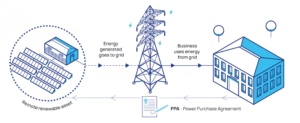
A corporate PPA is often sold as a bilateral hedge attached to a renewable asset: a fixed or indexed price on one side, “green” volumes on the other, and a reassuring narrative that volatility has been replaced by contract. That narrative survives only at a high level of abstraction. Performance is produced inside a system that insists on its own categories and disciplines, above all balance groups, mandatory scheduling, deviation settlement and system services. The hidden trading layer is not an interpretive flourish. It is the operational and financial chain of forecasting, nomination, intraday adjustment, portfolio netting and settlement that converts intermittent generation into hedge-relevant delivery.
This matters because the settlement baseline is not annual but granular. Balancing energy is defined against the deviation between confirmed schedules and metered values and settled at 15-minute resolution, with the regime explicitly framed as an incentive system designed to keep deviations “as low as possible”. Once this baseline is accepted, “hedge performance” cannot be located in the strike price alone. It is a property of the chain that determines how generation and load are translated into schedules, how residual volumes are traded close to delivery, and how deviations are attributed and priced when reality diverges from plan.
The broader point is structural. Electricity risk is not eliminated by long-term contracting; it is transformed. Scarcity, network constraints, and episodic liquidity thinning embed non-linearities and tail outcomes into the system, so the central question becomes how risk is redistributed across instruments, time scales and counterparties (Billimoria, F., Mays, J., & Poudineh, R. (2024). Risk hedging in electricity markets. Oxford: Oxford Institute for Energy Studies). A corporate PPA behaves like a hedge only when it contracts the transformation layer that links intermittent production to the buyer’s load and to the balancing regime that monetises deviations.
I. The hidden trading layer as the hedge’s production function
The hidden trading layer can be described, without metaphor, as the hedge’s production function. It performs three conversions that are often compressed into a single “delivery” sentence in term sheets, and then reappear as cost drivers in settlement.
First, shaping and firming: the conversion of a stochastic generation process into a delivery profile that is meaningful relative to the buyer’s load. The relevant object is not annual MWh but a time series of net positions, because the buyer’s all-in procurement cost is driven by the residual position that remains after the PPA is netted against consumption.
Second, nomination and scheduling: the conversion of commercial intent into system-recognised schedules. This interface is governed by procedural and information-system constraints, and the position that matters for settlement is the position nominated and accepted under the balance group discipline.
Third, deviation governance: forecast errors, intraday corrections, metering adjustments, curtailment and operational constraints generate deviations. Deviations are the channel through which intermittency and stress are monetised. A contract that does not allocate deviation categories does not reduce risk; it leaves the system to allocate them by default.
This framing is consistent with the classic insight that electricity markets are coupled institutional arrangements, not single markets: balancing and ancillary services are constitutive, and reform outcomes depend on how these coupled layers are designed and coordinated (Jamasb, T., & Pollitt, M. (2005). Electricity market reform in the European Union: Review of progress toward liberalization and integration. The Energy Journal, 26(Special Issue), 11-41). The shift toward variable renewables tightens that coupling by relocating system value toward timing and flexibility, making the interface between short-term markets, network constraints and investment incentives economically central (de Vries, L. J., & Verzijlbergh, R. A. (2018). How renewable energy is reshaping Europe’s electricity market design. Economics of Energy & Environmental Policy, 7(2), 31-50).
II. Volume risk decomposed: resource risk, profile risk, and settlement risk
“Volume risk” is commonly treated as a single exposure: underproduction relative to expectation. Operationally, that is too coarse. A coherent allocation requires separating three exposures, because each is controlled differently and priced differently.
Resource and availability risk is the stochastic uncertainty in output driven by meteorology and technical performance. This is the exposure most readily addressed with warranties, floors, caps and proxy constructs.
Profile (shape) risk is the misalignment between the hourly distribution of generation and the buyer’s load. Even when annual MWh match expectations, a structurally wrong profile creates systematic residual positions that must be traded in day-ahead and intraday markets, often in hours where spreads widen. Quantitative work treats PPA books as portfolios and shows that diversification across assets and technologies can measurably reduce financial risk and improve match quality with demand, turning “multi-asset structuring” into a risk-control technique rather than a narrative preference (Gabrielli, P., Aboutalebi, M., & Sansavini, G. (2022). Mitigating financial risk of corporate power purchase agreements via portfolio optimization. Energy Economics, 110, 106028).
Settlement (imbalance) risk arises from the discipline imposed by the balancing regime: deviations between confirmed schedules and metered values are monetised at a fine temporal resolution. This means forecasting quality, nomination discipline and timing of intraday adjustment are first-order financial drivers. Evidence from balancing market microstructure reinforces why this cannot be treated as a back-office matter: information flows and disclosure lags can shape the ability to anticipate system imbalance and can generate strategy value tied to timing and proximity to delivery (Bunn, D. W., & Kermer, S. O. E. (2021). Statistical arbitrage and information flow in an electricity balancing market. The Energy Journal, 42(5), 19-40). The contractual implication is precise: whoever controls forecasting and intraday steering controls a variable that affects both the mean and variance of imbalance outcomes.
A serious corporate PPA therefore needs to state which of these risks are borne by the buyer, which are delegated to a sleeve provider, and which are capped, benchmarked or insured. Otherwise allocation is left to default settlement economics and to informational asymmetry.
III. Shaping costs as basis risk: the monetisation of mismatch
Shaping costs are better understood as the monetisation of basis risk: the spread between the PPA’s generation profile and the hedge-relevant delivery profile implied by the buyer’s load and the balancing regime. Shaping is path-dependent. It depends on intraday volatility and liquidity, forecasting accuracy, technology seasonality, and critically the portfolio context of the shaper. A party with a broad portfolio can net residual positions and reduce exposure; a standalone buyer typically cannot.
This is why sleeving is not a cosmetic intermediary layer but an economic choice about who holds operational control over forecasting, nominations, balancing interface management and residual procurement. A flat sleeve fee can look like stability, yet if the buyer lacks data rights and ex post reconstruction capability, the fee behaves as a discretionary product whose embedded option value grows with volatility. The long-tenor hedging literature is clear that electricity risk markets can remain incomplete, so long-term contracts are often asked to substitute for missing hedging instruments, which makes auditability and governance part of hedge quality rather than an administrative preference (Billimoria, F., Mays, J., & Poudineh, R. (2024). Risk hedging in electricity markets. Oxford: Oxford Institute for Energy Studies).
IV. Imbalance and control energy: institutions determine the cost surface
Imbalance settlement is an incentive mechanism. The corporate rarely sits as a balance group manager, but it bears costs through contractual pass-throughs. If imbalance is passed through without allocating operational control and without caps or benchmarking, the buyer acquires uncapped exposure to a cost category designed to be consequential.
Comparative evidence is useful because it shows that balancing outcomes are not dictated by physics alone. German data suggests that contracted control power reserves and procurement costs can decline even as variable renewables expand, implying that forecasting quality, product design, market rules and TSO cooperation can materially shape reserve procurement and cost outcomes (Hirth, L., & Ziegenhagen, I. (2013). Control power and variable renewables: A glimpse at German data. Milan: Fondazione Eni Enrico Mattei). The implication is that imbalance exposure is a policy and institutional object, likely to evolve over a long PPA horizon. That evolution should be recognised contractually through governance, transparency and risk limits rather than absorbed as an undefined pass-through.
The informational point is not academic. Where imbalance outcomes are sensitive to timing and to intraday action, and where information flows can generate strategy value, data rights and control over forecasting and nominations become economic clauses (Bunn, D. W., & Kermer, S. O. E. (2021). Statistical arbitrage and information flow in an electricity balancing market. The Energy Journal, 42(5), 19-40).
V. Regulatory exposure: tariff stack, policy instruments, and market design drift
A PPA strike price is not an all-in hedge number. The all-in procurement cost includes the system cost stack and its evolution. Reserve instruments and tariff components are explicit and politically salient. The tariff stack includes reserve-related components such as a power reserve tariff and has been publicly communicated for the transmission grid. A long-term contract that treats these elements as generic pass-throughs, rather than mapping them to defined categories with specified change mechanisms, is structurally fragile: it cannot protect the buyer against redesign, reclassification or expansion of system cost instruments.
Policy trajectory matters because it shapes the cost stack and incentives for flexibility. The Federal Act on a Secure Electricity Supply from Renewable Energy Sources reshapes arrangements for production, transport, storage and consumption, with staged entry into force and acknowledged implementation uncertainty. Reserve instruments, including winter reserve measures, affect the cost stack and scarcity dynamics that shape residual procurement and imbalance pricing.
European market design drift matters because the system is embedded in European flows and price formation. Recent analysis identifies supply-demand mismatch risk in systems with rapid renewable deployment and de-risking schemes, with distributional and political implications (Heussaff, C., & Zachmann, G. (2024). The changing dynamics of European electricity markets and the supply-demand mismatch risk. Brussels: Bruegel. ). Integration research shows time-varying volatility connectedness across neighbouring markets (Do, H., Nepal, R., & Jamasb, T. (2020). Electricity market integration, decarbonisation and security of supply: Dynamic volatility connectedness in the Irish and Great Britain markets. Cambridge: Energy Policy Research Group, University of Cambridge). Policy work on consumer-led transition underscores the centrality of flexibility and demand-side participation ( E3G. (2016). Consumer-led energy transition: Leveraging the actions of progressive energy consumers to deliver the EU energy system of the future. London: E3G.).
Regulatory exposure is not only statutory change; it is also enforcement and institutional incentives. Political economy analysis reminds that enforcement capacity can be shaped by stakeholder dynamics and institutional constraints (Maggetti, M. (2019). Interest groups and the (non-)enforcement powers of EU agencies: The case of energy regulation. European Journal of Risk Regulation, 10(3), 458-484). Over a 10-15 year horizon, this affects the probability that rule application and tolerated practices drift, with real cost implications.
VI. Contract architecture: aligning private allocation with public settlement and measurable risk metrics
If the goal is an effective hedge, the contract architecture must align private-law allocation with public-law settlement reality.
First, specify settlement granularity and residual valuation logic in a way that is coherent with the system definition of deviation. If the contract settles annually or monthly, it should state explicitly how that settlement maps onto deviation settlement at the system level, and which party bears the basis risk created by that mapping.
Second, treat shaping as a priced transformation with traceability. Where shaping is delegated, specify reference markets or indices for residual procurement, allocation methodology, the information set used for forecasting, nomination timing, and the buyer’s data rights to reconstruct decisions ex post. A hedge transformation that cannot be audited is, economically, a discretionary product.
Third, use measurable risk metrics rather than rhetorical risk. Portfolio optimisation results support diversification as a risk-control method (Gabrielli, P., Aboutalebi, M., & Sansavini, G. (2022). Mitigating financial risk of corporate power purchase agreements via portfolio optimization. Energy Economics, 110, 106028). Risk-based valuation highlights the relevance of quantifying credit risk and expected loss for guarantees and collateral design (Pombo-Romero, J., Rúas-Barrosa, A., & Vázquez, M. (2024). Assessing the value and risk of renewable PPAs: A risk-based approach. Energy Economics, 135, 107264). Balancing market microstructure supports treating information, timing and control as economic variables (Bunn, D. W., & Kermer, S. O. E. (2021). Statistical arbitrage and information flow in an electricity balancing market. The Energy Journal, 42(5), 19-40).
Fourth, map regulatory pass-throughs to defined tariff categories and policy instruments, and draft change mechanisms capable of capturing redesign and reclassification of system cost components, not only formal statutory amendments.
Conclusion: the hedge is the trading layer
A corporate PPA is not a bilateral abstraction. It is a structured interface between private allocation and system settlement. The hidden trading layer is the hedge’s production function. If it is priced, governed and auditable, the contract behaves as a risk-reducing instrument because it controls the channels through which intermittency becomes cashflow (Billimoria, F., Mays, J., & Poudineh, R. (2024). Risk hedging in electricity markets. Oxford: Oxford Institute for Energy Studies). If it is left implicit, the contract behaves as a long-dated position whose volatility surfaces under stress, when imbalance regimes bite and informational control over forecasting and nominations becomes decisive (Bunn, D. W., & Kermer, S. O. E. (2021). Statistical arbitrage and information flow in an electricity balancing market. The Energy Journal, 42(5), 19-40; Hirth, L., & Ziegenhagen, I. (2013). Control power and variable renewables: A glimpse at German data. Milan: Fondazione Eni Enrico Mattei; Heussaff, C., & Zachmann, G. (2024). The changing dynamics of European electricity markets and the supply-demand mismatch risk. Brussels: Bruegel. ).
The conclusion is austere, but it is accurate. The hedge is not the headline price. The hedge is the trading layer. The only serious question is whether the contract governs that layer as an object of measurable risk, or whether it discovers it through settlement.
Leave a Reply